Adsforblog

Thursday, March 3, 2011

Getting Ahead of the Curve

The questions are these:

Is it better to know ahead of every other rejectee that your work was not selected in some competition you entered

or

Is it better to sit blissfully in the dark and hear the news when it is officially announced?

The Steiny Road Poet has accidentally, not once but twice, within the last two months learned ahead of the curve the outcome of competitions where her work was under consideration.  The only advantage she can see is that she, unlike other artists not selected,  did or will recover from her disappointment well before the announcement was or will be made public.

Life for the artist after all is one rejection after another. Some of us, because we came from dysfunctional families where we were loved imperfectly or not at all, have lots of rejection training. Still, we want our creations, our artistic babies, welcomed into the world and given the opportunity to be loved.

So how do the beans get spilled in advance so that someone like the Steiny Road Poet finds out without trying to know the outcome? In one case, she was discussing business with someone she has never met before and they start telling each other personal details that led to the do-you-know-my-friend-so-and-so game which then innocently led to the info that so-and-so just had her work selected by a big New York City performing group. The Steiny Road Poet knew exactly what was being said without losing a beat on the business conversation. However, she immediately called the NYC performing group and got verification that their selections had been made. Of course, they wouldn't say more but it was a fact that no communication had come across to the S.R. Poet. In the second case, she was having a conversation with a friend. In talking about about recent non-selections, the friend mentioned casually that a small piece of hers was selected by a DC area group and oh, it was really nothing but it made her feel good anyway. Again, the S.R. Poet recognized instantly that her own work had been passed over but not officially rejected since no announcements have been made yet. The Poet is very happy for her friend and told her so.

Now back to the drawing board and maybe the Poet needs to start practicing how to throw a curveball.

Wednesday, February 9, 2011

Who Stole Langston & Is This News?


The Steiny Road Poet meant to post yesterday February 8, 2011, when The Washington Post finally made mention of the Associated Writing Programs (AWP) Convention and Bookfair in what basically turns out to be a gossip column called "The Reliable Source. The Poet had been thinking what a big oversight The Post had made in not covering any aspect of this writers’ gathering where prominent writers from across the world, but particularly American writers gather to discuss ideas, literature, politics, and more as well as present new and old books of importance.

In case you, my Dear Readers, do not subscribe to the venerable institution of print news and, in particular The Washington Post, in a nanosec, here is the story that continues to unfold, two days running, into a polemic against the always generous Andy Shallal, owner of Bus Boys & Poets, a restaurant in Washington, DC. Poet Thomas Sayers Ellis says he stole the cardboard cutout of Langston Hughes that Shallal had had made for Bus Boys, which is named after the poet who had been a restaurant bus boy in Washington, DC, when his first book The Weary Blues was accepted for publication by Knopf. After highjacking the Langston cutout, Ellis paraded it through the AWP Bookfair at the Marriott Wardman Park Hotel. Ellis accuses Shallal of not paying poets fairly for their public readings at Bus Boys.

The Steiny Road Poet stands firm behind Andy Shallal and is OK with the gossip column "The Reliable Source" because it is fun but she takes The Washington Post to task for not giving appropriate coverage to the AWP Convention that included such writers as 2000 Pulitzer Prize-winner Jhumpa Lahiri (Conference Keynote speaker), 2008 Pulitzer Prize-winner Junot Diaz, and former U.S. Poet Laureate Kay Ryan as well as such topics as the revolutionary changes involving print into digital formats for books, journals, and newspapers. 

Sunday, February 6, 2011

Finding Happiness at 2011 AWP DC


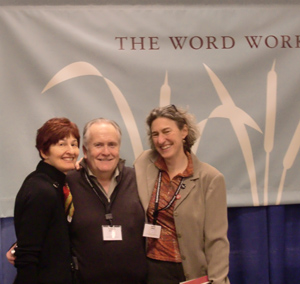
If anyone mentioned that he or she had never seen the Steiny Road Poet happier than the four days she spent at the Associate Writing Programs (AWP) Convention & Bookfair, this would be absolutely true. She has found that passing The Word Works scepter to Nancy White, a former winner of the Washington Prize, has made this literary organization suddenly leap into the future -- we are now taking manuscripts for the Washington Prize electronically. We have a gorgeous new logo. We updated our Internet name to WordWorksBooks.org. We are sending electronic newsletters. We are saving money with print on demand production of our books. And we bought an expensive piece of real estate at AWP -- a booth with two big tables -- and covered all the costs by selling lots of of our beautiful books!

One particular high point was the celebration reading of selected Washington Prize winners as a scheduled event of the AWP catalogue. There were around 60 people in the audience to hear Nathalie Anderson, Peter Blair, Fred Marchant, Brad Richard, Jay Rogoff, and Enid Shomer. Fred moderated and created a warm community feeling for the program that included more than the usual nods to Nancy and the Steiny Road Poet. And it was February 3, 2011, Gertrude Stein's 137 birthday! Fred chose to read poems by both Nancy & S.R. Poet, including Karren Alenier's "Stein Writes It All Down."


The last day of AWP, the Steiny Road Poet paused for photos with friends Deborah Ager and Reb Livingston, with whom she also had photo opps at the 2009 AWP Conference in Chicago.  How things come full circle.

Sunday, January 2, 2011

More Allen Ginsberg Than You Would Want to Know

The Steiny Road Poet entered 2011 with just a few more pages to read of Bill Morgan's I Celebrate Myself: The Somewhat Private Life of Allen Ginsberg. It's a funky biography by a man who worked closely with Ginsberg and on Ginsberg's vast archive of works.

Morgan's bio of Ginsberg is funky because it is not totally objective. Still, Morgan's spin on Ginsberg doesn't get in the way of the documentation which is extensive. The Steiny Road Poet walks away from this record of years that she could not put down understanding a much bigger picture of the Beat poet whom she personally experienced as a tremendously generous person and, much more surprising, filling in gaps in her understanding of what happened in America from 1950-1990 and how it affected her.

And no, she didn't know that Ginsberg had more than a passing acquaintance with Paul Bowles. Those familiar with Bowles and the Beats have seen the 1961 photo of them together in Tangier. She knew from Paul Bowles himself that he had visited with the Beat writers when they visited William Burroughs in Tangier. However, Bowles was careful to say, and said it in the interview the Steiny Road Poet and two journalists did with him in 1982 (see Conversations with Paul Bowles p. 128), that he was not involved with Beat writing.  In 1961, Bowles invited Ginsberg to spend a week with him at a house in Marrakech. (In I Celebrate Myself, Bill Morgan claims the house belonged to Bowles—see p. 333, but that may be confused with the house he owned in Tangier.)  In 1993, Ginsburg made one last trip to see Bowles. Bowles, who died in 1999, outlived the younger Ginsberg by two years.

What led to Ginsberg's death was Hepatitis C that he had contracted in South American in 1960.  More surprising is that he did not contract the AIDS virus over his life time of multiple sex partners and this bio does not skimp on the outrageous sexual adventures of this son of a high school teacher. Another surprising fact about Ginsberg is that he always went after straight men. His life time partner Peter Orlovsky was a straight man who had many girl friends but Peter came from a family challenged by mental illness. Eventually mental illness and severe drug addiction plagued Orlovsky and his relationship with Ginsberg.  

Articles on Ginsberg by Karren Alenier
Photos of the Beat Poet, Allen Ginsberg
Howl: Absorbing Poetry through Film
Howling in the Nation's Capital
Playing the Hydrogen Jukebox                                                                                                                                                                                                    

Sunday, November 21, 2010

10 Minutes: A Play

Here, the Steiny Road Poet is not asking for your ten minutes, maybe only one.

She has written a ten-minute play entitled "Who Killed Jackie Bass." The title is a statement not a question. This poetic play is important to the Poet because it is a memorial to a murdered relative.

The play has been submitted to a competition and now the Poet would like your help in putting good energy into the universe so that even if the play doesn't make it to the stage this summer, the title will get caught in collective consciousness.

Here's a quote from the play:
"Did you ever meet Jackie Bass? You wouldn’t forget her. She had smile larger than her hands and her hands were so warm—they were better than gloves in January."

So, please, no applause now—just give the Poet a cyber-hand and send along your star-powered energy to keep this title alive.