If asked earlier this summer, the Steiny Road Poet would have said political operas are not her kind of torch—that she would rather ignite something more exotic. However, by accident or intervention from the universe, she got involved with the
Dana Beyer campaign that would have put the first transgendered woman into a United States political office. The Poet was told that if the candidate got 5,000 votes, she would win. Dana Beyer made her goal but the three incumbents got more votes and kept their seats.
What did the Poet learn?
1. Hard work and integrity are not enough to win. Does this sound like the business of getting an opera on stage? While Ms. Beyer visited 10,0000 doors in her district and people whom the Steiny Road Poet met after the fact were impressed by the candidate’s sincerity, intelligence, and record of achievement, it did not enable the candidate to push past the weakest incumbent although it was respectably close. Apparently a teacher’s union push made the difference in getting a significant people out of their apathy to go down to the polls to vote.
2. Ordinary people, including the Poet, do not like being interrupted by phone calls about who to vote for. They especially hate robo calls. Never mind that you haven’t read the literature or websites on the candidates, who wants a computer generated call to tell you what to do? Do the
Millennials have this right about
not communicating by direct phone calls? Text them or grab them by the sleeve or there is no exchange. More people told the Poet that coming to their doors to talk about Dana Beyer was the preferred communication. And OMG, the deluge of paper sent to each household! An entire forest went under in just the Maryland primary election alone.
3. With some voters, there is no winning ever. A handful of people said, “I am not a Democrat” despite being carried on the Democratic register. “It’s too much trouble to change parties,” one bubby told me while asking me why I thought the Democrats were not responsible for our government’s huge debt. When the Poet pointed out (much against the instruction of her campaign manager’s advice to never argue with the voter) that Bill Clinton left office with U.S. finances in the black and George W. Bush left the American people in a deep red hole, the old woman looked at the Poet blankly. Then the Poet realized the woman had been brainwashed by someone close to her and so she backed away quietly. Also there were people who complained bitterly about how many times campaigners came to their doors and this was their reason not to vote for a sufficiently qualified candidate.
4. Privacy? Unless you have zero contact with the world, people with Palm Pilots know where you live, how old you are, and how you voted in the last election.
5. This was not entirely a thankless job. In this market, there were people with advanced degrees walking door to door in 90-degree heat to carry the message of candidates like Dana Beyer. They weren’t volunteers either and they got less pay in their pocket after taxes than minimum wage. However there were some people who understood how hard the job is and they thanked the Poet for doing this work.
6. Some people in one of the wealthiest counties in America do not keep up their property. Just stepping onto their porches was dangerous.
Did the Poet run into people she knew on the campaign trail? Yes, other poets, composers, a government official she worked with long ago and she also campaigned on a street where she once lived with her parents and siblings.
Does the Poet have any ideas for an opera? Yes, she thinks she could write a 10-minute opera about the incredible people who came to the door to talk to her. People like the friendly bubby who was making stuffed cabbages, the deaf woman she signed with based on having learned how to say more with her finger tips, the woman who arrived home on her bicycle and insisted the Poet sit down with her on the front porch to talk about the candidate’s politics, the rabid Republican spouse of a registered Democrat who wasn’t home, just to picture a few.

 One particular high point was the celebration reading of selected Washington Prize winners as a scheduled event of the AWP catalogue. There were around 60 people in the audience to hear Nathalie Anderson, Peter Blair, Fred Marchant, Brad Richard, Jay Rogoff, and Enid Shomer. Fred moderated and created a warm community feeling for the program that included more than the usual nods to Nancy and the Steiny Road Poet. And it was February 3, 2011, Gertrude Stein's 137 birthday! Fred chose to read poems by both Nancy & S.R. Poet, including Karren Alenier's "Stein Writes It All Down."
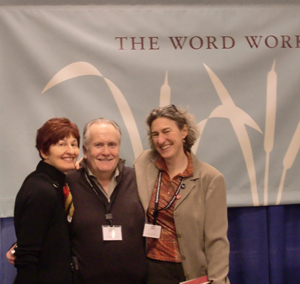
 The last day of AWP, the Steiny Road Poet paused for photos with friends Deborah Ager and Reb Livingston, with whom she also had photo opps at the 2009 AWP Conference in Chicago. How things come full circle.





 Posts
Posts

